Wilhelm Heinrich von Dohren (Second Generation)
Der goldene HandschuhWilhelm Heinrich von Dohren (Second Generation) is the second-generation head of the von Dohren shipping business, a once-successful shipbroker whose fortunes collapse under business setbacks and an international crisis. At the family’s formal dinner table, he occupies the middle place between his embittered father, Wilhelm Heinrich von Dohren (First Generation), and his detached seventeen-year-old son, Wilhelm Heinrich von Dohren (Third Generation). His story joins private exhaustion to the wider disruptions reshaping shipping: the business that once made him rich has been damaged by rivals, misjudgment, and ships stranded for years in the Suez Canal.
Position in the Family
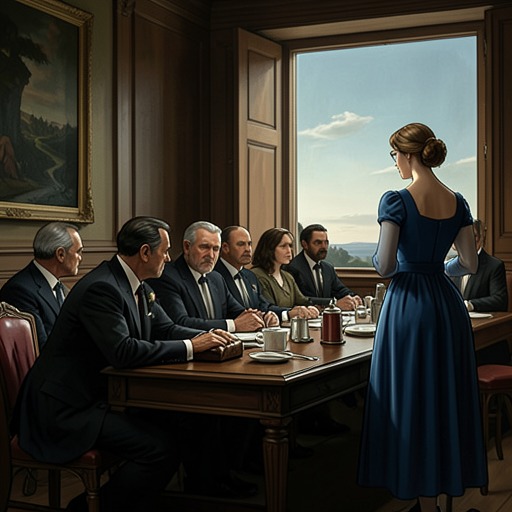
At fifty-seven, Wilhelm Heinrich von Dohren (Second Generation) sits with his father, seventy-nine, his son, seventeen, and his wife, Margot von Dohren, fifty-three, for the household’s punctual 7:30 p.m. dinner at the von Dohren Family Estate. The meal follows an established ritual, with a succession of carefully prepared courses and conversation kept to safe topics. The table’s formal order places him within a family structure that appears stable, even as its business and its members’ prospects are under pressure.
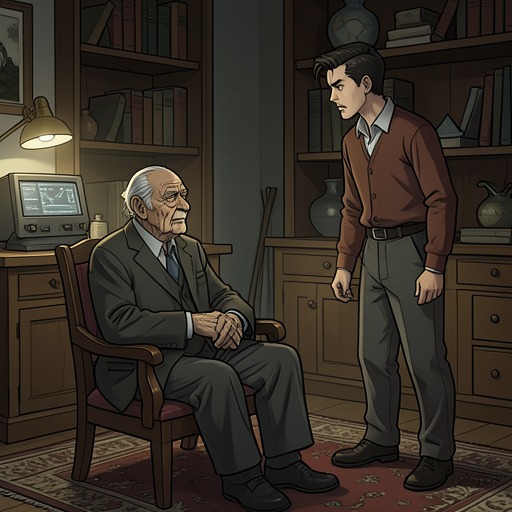
That structure is also a contrast between generations. Wilhelm Heinrich von Dohren (First Generation) sits sunk into his armchair-like stillness, consumed by accumulated grievances and thoughts of revenge. Margot finds the grand dining room oppressive and would rather move to a smaller one, but expects no change while her father-in-law is alive. Wilhelm Heinrich von Dohren (Third Generation), meanwhile, is preoccupied neither with the company nor with public affairs: he picks the strawberries from dessert and is absorbed by football and girls. The second-generation businessman is thus positioned between a father fixed on past injuries and a son who shows little interest in inheriting the concerns that dominate his life.
Early Success in Shipping
After taking over the firm, Wilhelm Heinrich von Dohren (Second Generation) initially achieved considerable success. A principal source of that prosperity was compensation trade with East Germany, a system that enabled large profits despite the state’s practical lack of foreign currency. When East German shipbuilding needed steel that Russia could not supply in the required quality, the steel could be purchased from western companies such as Thyssen. The completed ships were then sold to West German shipowners.
Specialist shipbrokers were inserted between the parties to arrange these transactions and collect enormous commissions. Wilhelm Heinrich von Dohren (Second Generation) was among the major beneficiaries; the deals made him a fortune by Hamburg standards. This early success matters to the shape of his decline: his position is not presented as one of uninterrupted failure. He has known the power and rewards of a thriving business, making the later collapse a reversal of a life once apparently secured by commercial skill and favorable circumstances.
Displacement and Commercial Misjudgment
That prosperity ended abruptly. The Hinnebergs displaced him from the business under circumstances described as deeply ugly, leaving him defeated and effectively ruined. His loss is not attributed solely to their actions. Business decisions of his own, mismanagement, and bad fortune compounded the damage, while the container revolution of the mid-1960s exposed a failure to recognize how profoundly shipping was changing. Like many shipowners, he understood the transformation too late.
The account therefore gives his predicament several connected causes rather than a single antagonist or mistake. Rival pressure coincides with failures of management and judgment; an industry-wide change magnifies those weaknesses. His former success and present defeat belong to the same commercial history, but they produce sharply different conditions: once he profited from complex trade, he now doubts his capacity to rescue the business at all.
The Fleet in the Suez Canal
One of the company’s eleven ships has been caught in the Suez Canal since Egypt closed the waterway in 1967 in response to the Six-Day War. The ship’s confinement, initially seeming like an absurd turn of world events, has lasted seven years by the time of the scene and cost the company immense sums. The delay is neither a manageable interruption nor a problem with a predictable end: no one can say how long the vessel will remain there.
The stranded ships acquired the name Yellow Fleet because wind covered their decks with fine, yellow-shimmering desert sand. That image makes the commercial loss visible: ships built for movement lie held in place, their surfaces marked by the landscape around them. The fleet has become subject to unpredictable politics, while its prolonged immobility drains the company’s resources. For Wilhelm Heinrich von Dohren (Second Generation), the vessel is one part of a broader predicament in which external events and accumulated business failures leave him increasingly unable to act.
Exhaustion and the Family Dinner
By the time of the dinner, Wilhelm Heinrich von Dohren (Second Generation) feels backed into a corner. Approaching sixty, he no longer believes he can pull the business out of its difficulties; his energy is spent. He sees no young love or change of fortune ahead and does not imagine that he can begin a new life. In his estimation, a person can only continue the life already under way. He gives himself, at most, another year or a year and a half before expecting nothing further.
The dinner scene sets this inward depletion against the family’s outward ritual. The household assembles on time in a salon large enough for eighty people, beneath a black, low-hanging sky and amid faint scraping sounds of wind. The meal proceeds through its courses and its deliberately harmless conversation even as the company’s prospects darken. His despair does not interrupt the ceremony; instead, it gives the ceremony a strained quality, as though the formal continuities of family life can persist while the future they are meant to preserve has already become doubtful. The scene’s force lies in that mismatch: a business leader sits at the center of an orderly family table, yet privately expects neither recovery nor renewal.